
- PO BOX 1767
DANDRIDGE, TN 37725 - 865-344-0184
A grinding machine coolant filter removes swarf, grinding fines and tramp oil from the coolant before it returns to the wheel. Clean coolant is what keeps wheel life, surface finish and dimensional tolerance where the process sheet says they should be. Engineered Filtration, Inc. engineers and supplies grinding coolant filtration systems from 13 to 528 GPM in four technologies, with the specifications for every model published on this site, and has done so from Tennessee since 1995.
Why grinding coolant needs its own filtration
Grinding produces the finest and most abrasive contamination of any machining process. Wheel grit and metal fines in the 5 to 30 micron range stay suspended in the coolant, and once they recirculate they score the workpiece, load the wheel and shorten dressing intervals. A filter sized for a turning cell will pass most of it. A grinding coolant filter is specified by micron rating first and by flow rate second, and the media grade matters as much as the machine.
Which grinding applications we filter
Centerless grinding
High volume, continuous, and unforgiving of surface defects. A gravity bed filter on standard PLS 35 media handles most steel and cast iron work; a magnetic separator ahead of it removes the bulk of the ferrous fines and stretches media life.
Surface grinding
Lower flow, tighter finish. Finish grinding calls for the PLS 50 grade at 20 micron. A single Index 50 or Index 100 serves one machine.
Creep feed grinding
Heavy stock removal at high coolant flow. The Hydroflux hydrostatic filter suits creep feed because filtration quality improves as the cake layer builds and the unit handles the higher flow in a compact footprint.
ID and OD grinding
Precision bores and diameters where a single embedded particle scraps the part. PLS 50 or PLS 70 media, 20 and 10 micron respectively, on a gravity bed or hydrostatic unit.
Abrasive belt grinding and cutoff saw coolant
Coarser swarf and higher solids loading. A magnetic separator does most of the work on ferrous material; PLS 20 or PLS 25 media at 50 and 45 micron follows.
Choose your filtration type
Option 1. Gravity bed coolant filter (Index series)
Coolant flows by gravity through a flat bed of disposable media. When the media loads, a float switch indexes the bed forward and the used media rolls off into a tray. Ten models from 13.2 to 132 GPM of emulsion and 7.9 to 79.2 GPM of neat oil. The economy option, with an operator watching the media roll. Not installed in parallel; above 132 GPM the Hydroflux takes over.
Option 2. Hydrostatic deep bed coolant filter (Hydroflux series)
Dirty coolant is held above the media under a head of pressure. A compact cake layer forms on the media, so filtration starts at the rating of the medium and gets finer from there while using less media than a gravity bed. A rail system seals the media edge and eliminates bypass. Seven models from 42 to 528 GPM of emulsion. An end of roll switch is standard; a media rewinder is available on the Hydroflux 400 and above.
Option 3. Self cleaning drum coolant filter (Autoflux series)
A permanent drum screen with automatic backwash, for shops that do not want consumable media. Specifications on request.
Option 4. Magnetic coolant separator (Automag series)
A rotating magnetic disc pulls ferrous swarf out of the coolant stream and discharges it as damp sludge to a tray or bin. Twelve models from 13 to 528 GPM. Used ahead of Option 1 or 2 on steel and cast iron work, where it removes the bulk of the fines before they reach the media. Every Index and Hydroflux model has a matched Automag model; the pairing guide is on the Automag page.
Specifications at a glance
| System | Type | Emulsion flow (GPM) | Neat oil flow (GPM) | Media and micron | Magnetic | Best for |
|---|---|---|---|---|---|---|
| Index | Flat bed, disposable media | 13.2 to 132 | 7.9 to 79.2 | PLS, TEX or PLPWW rolls, 10 to 50 micron | With matched Automag | Single machine, economy, operator on hand |
| Hydroflux | Deep bed, disposable media | 42 to 528 | 21 to 264 | PLS, TEX or PLPWW rolls, 10 to 35 micron | With matched Automag | High flow, tight finish, short footprint |
| Autoflux | Self cleaning drum | 79 to 264 | 39 to 132 | Permanent screen | With matched Automag | No consumable media |
| Automag | Magnetic separator | 13 to 528 | 9 to 148 (1000P and above on request) | Not applicable | Is the magnet | Ferrous swarf ahead of media filtration |
Index or Hydroflux
| Criterion | Index flat bed | Hydroflux deep bed |
|---|---|---|
| Flow, emulsion | 13.2 to 132 GPM, ten models | 42 to 528 GPM, seven models |
| Flow, neat oil | 7.9 to 79.2 GPM | 21 to 264 GPM |
| Filtration range | 10 to 50 micron, the full media span | 10 to 35 micron. Not recommended at the coarse end, where media is a lighter, thinner sheet and is susceptible to ripping or tearing |
| Supply | Prebuilt and stocked. Small changes to a stock unit, such as adding an end of roll switch or changing the pump | Engineered. Larger, higher flow units built to order where the application flow rate requires them |
| When the buyer moves up | Above 132 GPM, or where the requirement goes beyond a small change to a stock unit | Takes over above 132 GPM and carries the special builds |
| Footprint | Index 150 is 80.7 inches long | Hydroflux 150 is 41.2 inches long, for installations where floor space is the constraint |
| Media conveyor drive motor | 0.06 kW on the 50 to 200, 0.18 kW on the 250 to 550L | 0.09 kW on the 150 to 400, 0.21 kW on the 600 to 2000 |
| Power | 230/460 V, three phase | 230/460 V, three phase |
| Pump | Matched to the application. No rating published | Matched to the application. No rating published |
Full model by model tables, dimensions and media part numbers are on each product page, with the PDF datasheet linked beneath the table. Media grades and widths are on the filter media page.
How grinding coolant filtration works
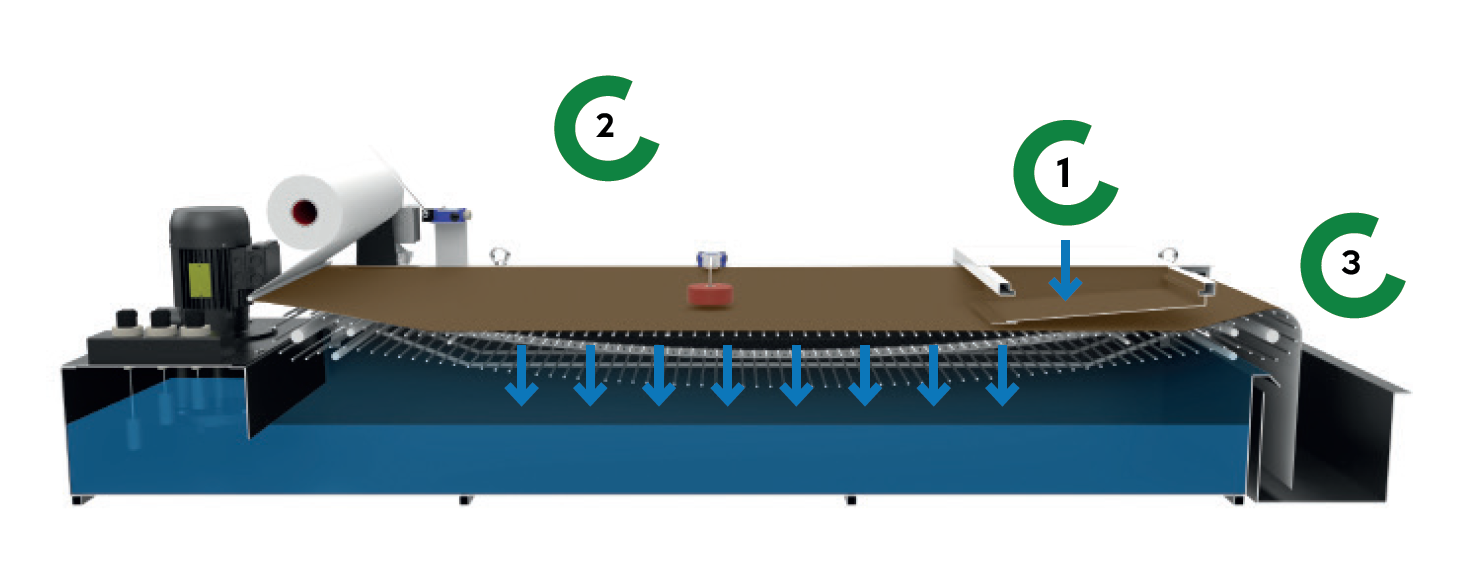
1. Dirty coolant enters
Coolant returns from the grinder to the dirty side of the filter. On a pumped return a pressure diffuser spreads the flow across the bed; on a gravity return a gravity diffuser does the same job. Where an Automag is fitted, the coolant passes the magnetic disc first and the ferrous fines leave the stream here.
2. Filtration and media indexing
Coolant passes through the media and the fines stay on top. As the media loads, the coolant level rises until a float switch advances fresh media into the bed. On a Hydroflux, hydrostatic head compacts the cake and filtration gets finer as the cycle runs.
3. Clean coolant returns
Filtered coolant collects in the clean tank and the clean coolant pump returns it to the machine. Size the clean tank at four to five times the flow capacity of the filter bed. The transfer pump serves the dirty side and the clean coolant pump serves the clean side; the two are never interchanged.
Selecting the right system
- Ferrous swarf only, or mixed? Steel and cast iron: add an Automag ahead of the media. Aluminum, brass, carbide or composites: media filtration alone.
- Required micron level. Roughing: PLS 20 or 25 at 50 and 45 micron. Standard: PLS 35 at 35 micron. Finish: PLS 50 at 20 micron. Mirror and super finish: PLS 70 at 10 micron.
- Single machine or central system. One machine up to 132 GPM: Index. One large machine or several on one system: Hydroflux.
- Floor space. At the same flow the Hydroflux is shorter than the Index; the Hydroflux 150 is 41.2 inches long against 80.7 inches for an Index 150.
- Water based or neat oil. Every EFI filter is rated for both, and the neat oil rating is roughly half the emulsion rating on the same model. Polypropylene media is for emulsion only; polyester and rayon suit both.
- Never run any filter past its rated capacity. Match the rating exactly where a match exists, step up where it does not, and never step down.
Frequently asked questions
What is a grinding machine coolant filter and why does a grinder need one?
A grinding machine coolant filter removes the 5 to 30 micron wheel grit and metal fines that grinding leaves suspended in the coolant. Without it those fines recirculate, score the workpiece, load the wheel and shorten dressing intervals. A filter sized for turning will pass most of them, which is why grinding coolant is filtered by micron rating first and flow rate second.
What micron rating do I need for grinding coolant?
Most steel and cast iron grinding runs on 35 micron media, the PLS 35 standard grade. Finish grinding uses 20 micron PLS 50, mirror and super finish use 10 micron PLS 70, and roughing or belt grinding uses 45 or 50 micron PLS 25 and PLS 20. The grade is a media choice, so the same filter covers all of them by changing the roll.
What is the difference between a gravity bed filter and a magnetic separator?
A gravity bed filter passes coolant through disposable media and captures every kind of solid; a magnetic separator captures only ferrous material, such as steel and cast iron, and does it before the media. On steel work the two are used together: the Automag removes the bulk of the fines and the Index or Hydroflux media handles the rest, which cuts media consumption.
Can one coolant filtration system handle both water soluble coolant and neat oil?
Yes. Every Index, Hydroflux and Automag model is rated for both, and the neat oil rating is roughly half the emulsion rating on the same unit; an Index 200 handles 52.8 GPM of emulsion or 26.4 GPM of neat oil. The media has to match the fluid: polyester and rayon suit both, while polypropylene is for water based emulsion only.
How often does filter media need to be replaced on an indexing bed filter?
The bed indexes itself as the media loads, so the roll is changed when it runs out, not on a schedule. Polyester and rayon media come on 100 yard rolls and polypropylene on 200 yard rolls. On an Index the end of roll raises a light or alarm and does not stop the machine; on a Hydroflux an end of roll switch is standard.
Do I need a central coolant system or an individual machine filter?
One machine up to 132 GPM of emulsion is served by an individual Index gravity bed filter. One large machine or several machines on one system moves to a Hydroflux hydrostatic unit, which runs from 42 to 528 GPM. Index units are not installed in parallel; above 132 GPM the Hydroflux replaces the Index rather than adding a second bed.
Which coolant filter is right for centerless grinding versus creep feed grinding?
Centerless grinding on steel is typically an Index gravity bed on PLS 35 media with an Automag ahead of it, sized to the machine’s return flow. Creep feed grinding runs higher coolant flow and benefits from the Hydroflux, whose hydrostatic head compacts the cake and improves filtration as the cycle runs. Both pair with a matched Automag on ferrous work.
How much floor space does a grinding coolant filtration system require?
An Index 50 is 66.9 inches long by 26.4 inches high; the largest Index 400 is 183 inches long. The Hydroflux is the short footprint option at the same flow: a Hydroflux 150 is 41.2 inches long against 80.7 inches for an Index 150, and the Hydroflux 2000 at 528 GPM is 98 inches. Full dimensions are on each product page.
Work With Engineered Filtration, Inc.
Tell us the grinding process, the coolant, the flow rate and the material, and an EFI engineer will specify the filter, the magnetic separator and the media grade as one system. Engineered Filtration, Inc. has engineered and supplied coolant filtration in the United States since 1995. Systems are stocked in Dandridge, Tennessee, and customized and upgraded in house before they ship. Request a quote below, call Monday to Friday, 8:00 am to 5:00 pm Eastern, or use the Filter Finder to match a replacement element.