
Tramp Oil Removal for CNC Coolant Sumps
Last updated:
Oil-Evac is a stationary tramp oil removal system that installs on one CNC coolant sump and stays there. A floating collector pulls tramp oil off the surface on a timed cycle through the working day, and a built in ozone module runs a separate daily cycle on the same tank. $4,995, in stock in Dandridge, Tennessee, with a 30 day trial.
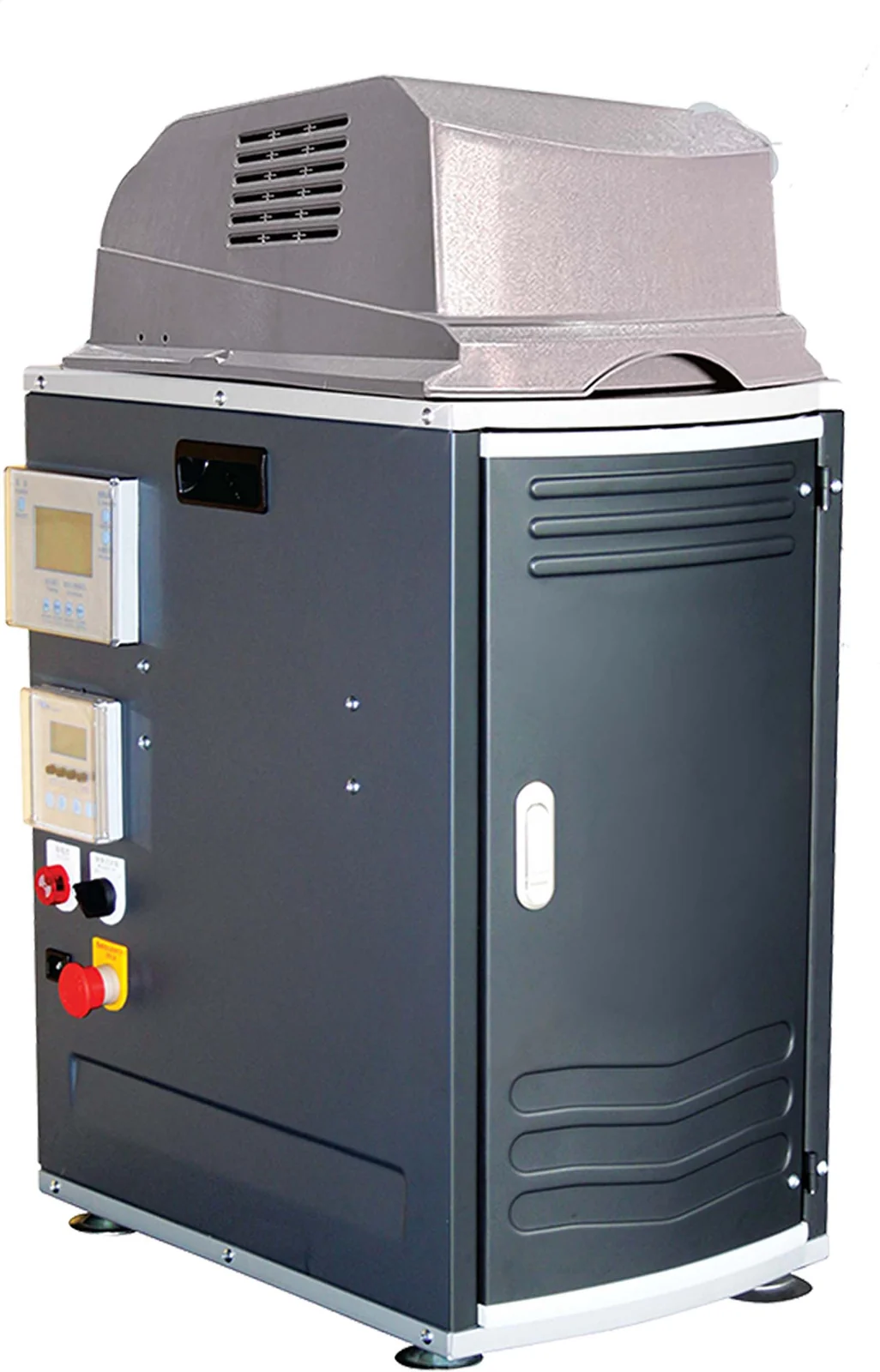
What is Oil-Evac?
Oil-Evac is a cart sized unit that sits beside one machine tool and is plumbed into that machine coolant sump permanently. It is not a portable vacuum and it is not wheeled between machines. A pneumatic pump draws the surface layer through a floating collector, separates the tramp oil into a 35 liter waste barrel you empty, and returns the coolant to the tank.
One unit serves one tank. That is a product rule, not a suggestion. Moving a unit between machines removes the continuous processing that makes it work, and the tank it left recovers its bacteria population while it is gone. A skimmer is a device you own. Oil-Evac is a process that lives on one tank and runs every day, and that difference is the reason it is worth more than a skimmer.
Is Oil-Evac an oil skimmer?
It contains an oil skimmer, but a skimmer alone is not what you are buying. A belt or disc skimmer lifts floating oil and stops there. Oil-Evac removes the oil on a timed cycle, separates it into a waste barrel, holds solids back with a cleanable stainless screen, and runs a daily ozone cycle on the same tank.
If your only problem is a visible oil film and you are content to empty a collection tray by hand, a belt skimmer at a few hundred dollars is the right purchase and we will tell you so on the phone. Oil-Evac is for the tank that went rancid again after the skimmer was installed.
Where does tramp oil in a coolant sump come from?
Tramp oil arrives three ways and none of them is operator error. Hydraulic fittings and hoses on the machine leak as it ages. Way lube is applied to the way covers by design and washes into the sump. And oil arrives on the incoming parts being machined. The oil is coming whether you like it or not. The only question is whether it stays.
Why does tramp oil make coolant go rancid?
Bacteria in a coolant sump feed on hydrocarbons, and tramp oil is the food supply. A layer of oil on the surface also blocks oxygen from reaching the coolant underneath, which favors the anaerobic bacteria that produce the sulfur smell. OSHA states that tramp oil promotes microbial growth by providing food for microbes.
The smell is sulfurous, closer to rotten eggs than to anything mechanical. Because natural gas is odorized with sulfur compounds, the two are easy to confuse.
Why does not more biocide fix it?
If biocide were the answer, your tank would already be fixed. You have been dosing it for years. Biocide kills what is in the water today and does nothing about what is feeding it. The tramp oil is still there tomorrow morning, and so is the food supply.
Remove the oil and you remove the food. That is the whole argument, and it is why a machine that runs every day on one tank does something a dose of additive cannot.


The clip above shows an Oil-Evac unit working on a machine coolant sump. The surface starts covered in a brown tramp oil film and finishes clear, with the collector drawing the oil off the top of the tank while the coolant stays in the machine. Nothing is drained and the tank is never removed.
Will Oil-Evac fit my sump?
Tank size does not limit Oil-Evac. Tramp oil floats, so the unit works at the surface and the gallons underneath make no difference to it. What governs the job is how fast oil arrives in your tank, not how much coolant is in it. A 40 gallon sump and a 150 gallon sump on the same kind of machine take the same unit.
Two measurements specify the unit we ship you, and neither of them is a limit. Tell us the depth of the coolant at normal running level and the size of the access opening in the tank top. The depth decides how the collector is mounted so that it rides at the surface. The opening decides whether it drops straight in.
| Coolant depth in the tank | Approximate inches | How the collector is mounted |
|---|---|---|
| 60 to 75 mm | 2.4 to 3.0 in | Fixed collector, no buoy |
| 75 to 100 mm | 3.0 to 3.9 in | Short buoy |
| 100 to 175 mm | 3.9 to 6.9 in | Confirm with us. The manufacturer table does not cover this band. |
| 175 to 210 mm | 6.9 to 8.3 in | Elevated seat |
| 210 to 240 mm | 8.3 to 9.4 in | Confirm with us. The manufacturer table does not cover this band. |
| Over 240 mm | Over 9.4 in | Floating collector, used with the short buoy. OPTIONAL EXTRA, quoted separately |
The largest standard coolant tank Haas sells is 95 gallons, so every machine in that range takes one unit without a conversation. On a central system serving several machines, call us. The oil removal still works the same way, because it is still a surface job, but oil arrives from more machines and that is the question we need to size against. The ozone cycle is also diluted across a larger volume, so on a big central tank Oil-Evac is a strong oil removal machine and a weaker ozone machine. We would rather say that before you buy than after.

What does Oil-Evac cost?
Oil-Evac is $4,995. That is the complete working unit: the ozone module, the air operated pump, the standard oil collector configured for your tank, and the waste oil barrel. It ships from stock in Dandridge, Tennessee, in a few days.
One option exists and it is the only one. A tank with more than 9.4 inches of coolant in it needs a floating collector instead of the standard one, and that is $125 on top. Tell us your coolant depth and we will tell you before you order, not after.
There is no filter media to buy. The filter screen is stainless mesh, which you clean and put back. One drive belt a year is the only wear part and it is $125. Nothing else on the machine is consumed.
How does the 30 day trial work?
We ship Oil-Evac on a purchase order and you run it on one tank for 30 days. You pay the freight in. At the end of the 30 days, if it is doing the job, you pay the invoice. That is the whole arrangement.
If it is not doing the job, tell us why and let us inspect the installation first. Most disappointments with this machine are an installation problem we can correct in an afternoon. If you still want to return it, clean the unit, repack it in the original crate, and pay the freight back to Engineered Filtration, Inc. We issue a credit when it arrives undamaged.
Give us your worst problem to solve first. Run the trial on the tank that smells the worst and gets dumped the most often. That is the one where the result is obvious to everybody in the building.
What does Oil-Evac need to run?
Oil-Evac needs a compressed air drop within hose reach of the sump, a 120V single phase outlet, and water soluble coolant. It does not run on straight or neat cutting oil. If your machine runs neat oil, this is not the right machine and we will say so before you order.
The pump is pneumatic, which is why the electrical load is only 42 watts, about 1 kilowatt hour per day. Air consumption is 17.66 SCFM while the pump is running, at 30 to 100 psi. The pump runs a 10 minute on, 20 minute off cycle, so consumption averaged across a shift is roughly a third of that peak figure. Any shop compressor sized for a CNC department has the capacity, and a larger air supply means the pump moves more fluid per cycle rather than less.
The clip above shows an Oil-Evac unit installed on a machine coolant sump. The unit sits beside the machine with the suction line into the tank and the collector riding at the coolant surface. It stays there. Nothing about the machine tool changes, no pipework comes apart, and the tank stays where it is.
What maintenance does Oil-Evac need?
Weekly, clean the filter screen, rinse chips from the collector seat and clean silt from the scraper blade. Check the collector water level and the buoy position while you are there. Monthly, brush sludge from the skimmer gears and belt and check the pipework. Each season, drain and clean the waste oil sump. Once a year, replace the belt. There is no filter media to buy at any point.
One caveat on the filter screen, because the honest answer is a range rather than a number. The manufacturer manual says check it daily. How fast it actually loads depends on how much fine material your tank carries, and a grinding sump throwing a lot of fines will load it faster than a milling sump will. Check it daily for the first fortnight, find out how fast yours loads, then set your own interval. Most tanks settle at weekly. You would rather learn that in week one than in month three.
Does Oil-Evac remove chips and sludge?
No. Oil-Evac removes tramp oil and holds back the solids that reach its own filter screen. It does not clean the chips and sludge off the bottom of your tank.
Coolant fouling is two problems, not one. Tramp oil is the food supply and the sludge on the tank floor is where bacteria live and breed. OSHA calls chip buildup an excellent nesting area for bacteria. Oil-Evac takes away the food. Taking away the home is a separate machine and we will have more to say about that shortly.
How long does the ozone run?
Three hours a day on a timer, not continuously. The ozone module produces 500 mg per hour and the control panel is set at the factory to run three hours daily, which is the manufacturer own recommendation. The panel will run it longer and we do not recommend it.
Ozone kills bacteria, fungus, yeast and mold on contact. It is one of the strongest oxidizers available for treating water, it ruptures the cell wall, and then it breaks back down into ordinary oxygen, so nothing builds up in your coolant and there is nothing to dispose of.
What it does not do is sterilize your tank. Water based coolant feeds bacteria on its own, and biofilm on the tank walls survives what the liquid does not. Anyone quoting you a bacteria count from an ozone module is quoting a number nobody has measured in your sump. We would rather tell you what it does and let the oil removal carry the argument.
Why not just add an ozone generator to my sump?
Because in a fouled tank the ozone has competition. A coolant emulsion carries an enormous load of oxidizable material, and the published work is clear that organics with a high ozone demand compete with bacteria for the ozone. Put a bolt on generator into a tank with a film of tramp oil still on the surface and a good deal of what it produces is spent on the oil rather than on anything living. That is the usual reason a shop concludes ozone does not work.
Keep the tramp oil off the surface every working day and you lower the load competing for that ozone, so more of it reaches what you bought it for. The two functions are not added together. Each one makes the other work, and that is the argument for doing both in one machine on one tank.
Which machines is Oil-Evac used on?
Any machine with a coolant sump of 300 gallons or less, running water soluble coolant, whatever the machine does. Mills, lathes, grinders, saws and machining centers are all the same job to this unit, because tramp oil floats and the machine underneath it makes no difference. It works beside the coolant filter already on the machine: the filter takes out the solids and Oil-Evac takes out the oil.
| Where Oil-Evac fits | |
|---|---|
| Yes | Any machine tool with a sump of 300 gallons or less running water soluble coolant |
| No | Machines running straight or neat cutting oil. This unit requires a water soluble coolant. |
| No | EDM machines. Dielectric fluid is not a coolant emulsion. |
| Call us | Sumps above 300 gallons, and central systems serving several machines. The oil removal still works, because it is still a surface job, but oil is arriving from several machines at once and that is a sizing conversation. The ozone cycle is also diluted across the larger volume. |
Which shops need Oil-Evac most?
Not an industry, a condition. Bacteria in a sump do not care what you make. A medical device shop and an oilfield shop with the same machine, the same coolant and the same weekend shutdown get the same smell on Monday. What decides whether you need this is the state of the tank.
- Tanks that sit idle over a weekend or a shutdown and smell on Monday.
- Older machines with hydraulic leaks, and machines that use a lot of way lube.
- Small sumps, where a little oil covers the whole surface.
- Shops dumping and recharging coolant every few weeks.
- Shops where operators complain about the smell, or about their skin.
- Shops that want to stop adding biocide.
- Shops audited on housekeeping, which in practice means aerospace and medical device suppliers.
If two or three of those describe a tank in your building, that is the tank to put the trial on. Give us your worst problem to solve first.
The clip above shows an Oil-Evac unit working on a copper machining coolant tank. Tramp oil floats whatever the machine underneath it is cutting, so the job is the same on copper as it is on steel or aluminium. What changes between shops is how fast oil arrives, not what the machine is making.
Oil skimmer, tramp oil separator, coalescer or centrifuge: which do you need?
Four different machines solve four different versions of this problem, and three of them may be the right answer for you. A belt or disc skimmer lifts floating oil off the surface. A tramp oil separator like Oil-Evac removes it on a timed cycle and holds the solids back as well. A coalescer merges fine droplets until they are large enough to draw off. A centrifuge spins out what the others leave behind. Here is what each one does, what it costs to run, and when to pick it.
| Belt or disc skimmer | Coalescer | Centrifuge | Oil-Evac | |
|---|---|---|---|---|
| What it removes | Free floating oil | Free and some dispersed oil | Free, dispersed and some emulsified oil, plus fines | Free floating oil, plus solids at its own screen |
| Typical US price | A few hundred dollars | About $1,000 and up | Several thousand up | $4,995 |
| Attended or not | Attended. Someone empties the tray | Attended. Media is cleaned or replaced | Attended. Bowl cleaning | Unattended on a timed cycle |
| Consumables | Belt or disc | Coalescing media | None, but bowl cleaning labor | One belt a year, $125. No media |
| Ozone | No | No | No | Built in, 3 hours a day |
| Pick it when | The oil film is the only problem and emptying a tray by hand is acceptable | You need better separation than a skimmer and will maintain media | Oil is emulsified into the coolant and nothing simpler has worked | The tank keeps going rancid after the skimmer was installed |
Oil-Evac specifications
| Field | Value |
|---|---|
| Price | $4,995 |
| Availability | In stock, Dandridge, Tennessee. Ships in days. |
| Coolant type | Water soluble coolant only. Not suitable for straight or neat cutting oil. |
| Application | Single machine coolant sumps. One unit per tank, permanently installed. |
| Collector configuration | By coolant depth. Standard, riser or floating collector. See the coolant depth table under Will Oil-Evac fit my sump. |
| Ozone output | 500 mg per hour |
| Ozone duty cycle | 3 hours per day, factory set. Panel range 1 to 9 hours. |
| Pump type | Pneumatic, air operated |
| Pump duty cycle | 10 minutes running, 20 minutes resting |
| Oil and water separation cycle | 25 minutes running, 5 minutes resting |
| Compressed air | 17.66 SCFM while the pump is running, 30 to 100 psi |
| Electrical supply | 120V, single phase, 60 Hz |
| Electrical load | 42 W (0.042 kW), about 1 kWh per 24 hours |
| Pump flow rate | 10 to 30 L/min (2.64 to 7.93 GPM), adjustable with air supply |
| Filtration | Cleanable stainless mesh screen, 400 micron (0.016 in). No filter media to purchase. |
| Waste oil barrel | 35 liters |
| Outlet diameter | 1 in |
| Wear parts | One drive belt per year, $125 |
| Operating dimensions | 520 x 410 x 880 mm (20.5 x 16.1 x 34.6 in) |
| Weight | 45 kg (99.2 lb) |
| Shipping dimensions | 560 x 450 x 930 mm |
| Warranty | 12 months from date of shipment, Engineered Filtration, Inc. |
| Included in the $4,995 | Ozone module, air operated pump, standard oil collector configured to your tank, waste oil barrel |
| Available as an option | Floating collector for tanks with coolant deeper than 240 mm (9.4 in), $125 |
Work With Engineered Filtration, Inc.
Engineered Filtration, Inc. has supplied coolant filtration and mist collection to metalworking and power generation since 1995. We stock Oil-Evac in Dandridge, Tennessee, we configure the collector to your tank before it ships, and we support it ourselves. Tell us the coolant depth in your worst tank and the size of the access opening, and we will tell you which configuration you need and what the trial looks like.
Engineered Filtration, Inc. | 2866 Beecarter Rd, Dandridge, TN 37725 | 865-344-0184
Call 865-344-0184 or email info@engfilt.net.